

When the battery warning light comes on in the instrument cluster (the battery-shaped icon), the most common reason is that the car is warning you about a charging system problem, not “just” the battery. If you keep driving, there may come a point when the vehicle runs out of power and stops.
At FQS BATTERY, we aim to explain how to help identify the problem with a very simple method: first observation, then 2–4 multimeter measurements.
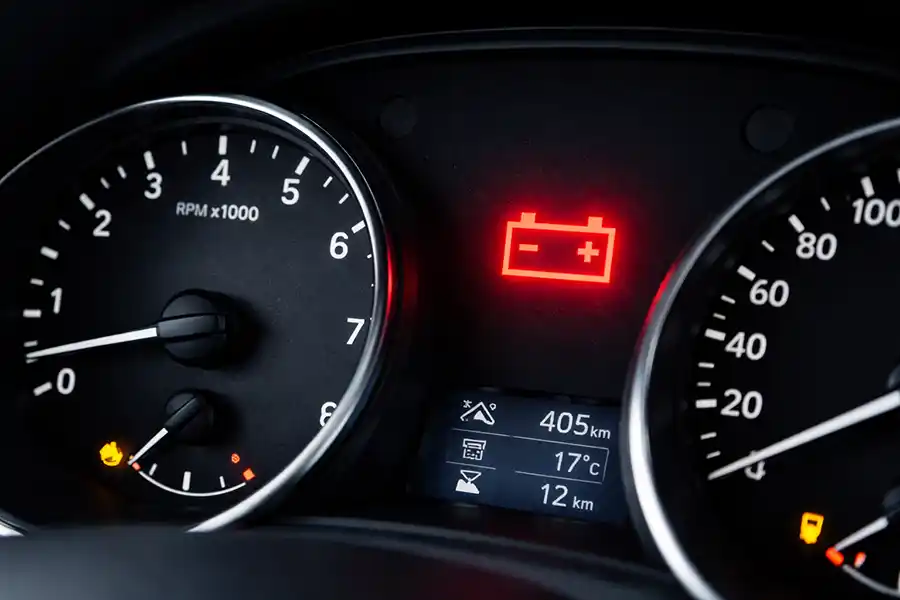
What the battery warning light means and how to diagnose whether the fault is the battery, alternator, belt, or ground with quick, safe checks.
WHAT DOES THE BATTERY WARNING LIGHT MEAN WHEN IT IS ON?
This warning light usually indicates that the battery is not being charged properly while the engine is running.
In many cars, this warning is triggered when the ECU detects low voltage, insufficient charging, or an electrical problem in the system.
CAN YOU KEEP DRIVING WITH THE BATTERY WARNING LIGHT ON?
It depends:
- It comes on when you switch the ignition on and goes off after starting: normal.
- It stays on steadily with the engine running: avoid long trips. You may be running “on the battery” and end up stranded.
- It flashes or appears intermittently: it may be a poor connection; still, it should be checked as soon as possible.
- It comes with other warnings (steering, ABS, engine fault): this is usually due to generally low voltage. High priority.
Practical tip: if you notice the lights dimming or the car starts doing “strange” things (messages, resets, heavy steering), stop and check it.
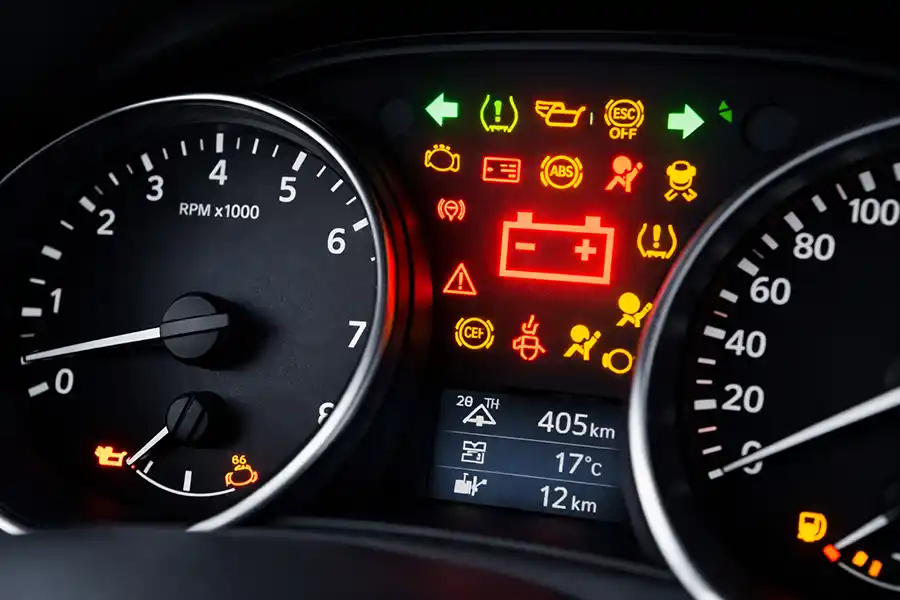
1 – QUICK CHECK WITHOUT TOOLS (1 minute)
Before measuring anything:
- Auxiliary belt (the one that drives the alternator): if it is broken, loose, or slipping, the alternator will not charge.
- Battery terminals: if they are loose or sulphated (white/bluish powder), charging or starting may fail.
- Ground cable (negative to body / engine): if it is corroded or loose, intermittent faults appear.
- Thick positive alternator cable: if there is overheating, scorched plastic, or a poor connection, there will be a voltage drop.

2 – DIAGNOSIS WITH A MULTIMETER
Measurement 1 — Voltage with the engine off
Measure directly at the battery terminals.
- 12.6–12.8 V: good charge.
- 12.4 V: medium.
- 12.2 V or less: discharged battery (or degraded if it happens repeatedly).
Note: for a “perfect” measurement, ideally the car should have been stopped for a few hours. But to diagnose the warning light, the important thing is to compare it with the engine running.
Measurement 2 — Voltage with the engine running (idle)
Start the engine and measure again at the terminals.
- Approx. 13.8–14.6 V: it is charging.
- 12.6–13.2 V: insufficient charging or a regulation/wiring fault.
- ≈12 V (same as with the engine off): the alternator is not charging (or the belt is not driving it, or there is a wiring/ground issue).
Measurement 3 — Voltage under load (real-world test)
Turn on the lights, rear window defogger, and blower fan.
- Normally it should stay close to 13.5–14.5 V.
If it drops to ≈12 V, the car is drawing from the battery.
3 – QUICK INTERPRETATION: WHAT IS MOST LIKELY?
A) With the engine running it shows 14 V and the warning light is still on
- Likely: a signal/sensor fault, smart charging management, or an electronic diagnosis issue (in modern cars).
- Recommendation: scan with a diagnostic tool (alternator/regulator/energy management codes).
B) With the engine running it stays at 12–13 V (not charging properly)
Most common suspects:
- Loose or slipping belt (sometimes with a “squeal”).
- Alternator/regulator fault.
- Fuse/link in the charging circuit (depending on model).
- Connections (terminals, positive cable, grounds).
C) Intermittent warning light (comes and goes)
Almost always:
- a loose or sulphated terminal,
- a poor ground connection,
- a loose alternator connector,
- a regulator with an intermittent fault.

4 – TEST FOR PROFESSIONALS
If you have access to the back of the alternator, these two measurements help distinguish between a “bad alternator” and “bad wiring”.
Positive voltage drop (alternator B+ to battery +)
With the engine running and loads switched on:
- Ideal: < 0.20 V
- If it is > 0.30–0.60 V: resistance in the cable, terminals, fusible link, splices.
Ground voltage drop (alternator case to battery –)
- Ideal: < 0.20 V
- If it is > 0.30–0.60 V: poor ground (engine-to-body, battery-to-body, corroded fasteners).
Key point: many failed “alternator replacements” were actually a ground or positive connection issue.
5 – WHEN TO SUSPECT THE BATTERY COULD BE THE PROBLEM
Although the warning light is usually related to charging, a degraded battery can “cause” symptoms.
Suspect the battery if:
- after charging it, it discharges quickly without use,
- starting is slow even with a good charge,
- a battery test (conductance/CCA) shows very low values.

6 – COMMON MISTAKES
- Replacing the battery “just in case” without checking whether the alternator is charging.
- Replacing the alternator without checking the belt and voltage drops.
- Ignoring sulphated terminals: they cause electrical faults that are difficult to trace.
- Continuing to drive with the warning light on steadily: it can end in a complete shutdown.
7 – FREQUENT QUESTIONS
- Does the battery warning light mean the battery is bad?
Not necessarily. It usually indicates a charging problem. The battery may be fine and the fault may be in the alternator/belt/wiring.
- What is normal with the engine running?
In most cases, 13.8–14.6 V at the terminals.
- Can it be dangerous to drive like this?
Yes, because if there is no charging, the car runs on the battery until it is depleted and may stop.
- Can it come on because of a bad terminal?
Yes. A loose or sulphated terminal can cause voltage drops and intermittent warnings.
PROFESSIONALS ARE THE BEST ANSWER
If you do not have experience working near the engine, avoid handling components with the car running. For basic measurements, it is enough to measure at the terminals carefully and without touching moving parts.

CONCLUSION
A battery warning light that stays on is almost never a battery issue: it is almost always a warning that the charging system is not working as it should. With a quick visual check and 2–3 voltage measurements using a multimeter, you can tell within minutes whether the problem is the alternator, the belt, a poor ground/connection, or a battery that is already degraded. Acting in time prevents you from being stranded and also avoids unnecessary part replacements. If in doubt, it is best to first check the alternator output and the condition of the terminals and grounds, and then assess the battery with a reliable test (CCA/conductance).