
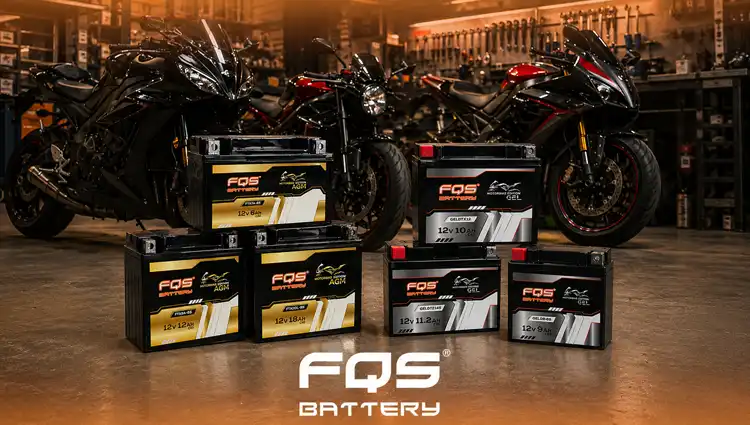
In the motorcycle battery market, few comparisons raise as many questions as AGM versus GEL technologies. Both are sealed, maintenance-free batteries and are clearly more advanced than older conventional flooded solutions. However, making the right choice does not depend only on price or size: it depends on whether the battery is compatible with the motorcycle, its charging system and the actual use it will have.
FIRST RULE: RESPECT THE ORIGINAL TECHNOLOGY
Before comparing technologies, there is one rule that should be made clear: the replacement battery must match the voltage, dimensions, polarity and specification required by the motorcycle. In addition, it is not advisable to change technology based on intuition or price if the vehicle manufacturer requires a specific one. At FQS BATTERY, we would like to remind you that using the wrong battery can shorten its service life, worsen performance and even cause premature failures.
That is why the question should not simply be “which battery is better”, but rather which battery that motorcycle actually needs.
TWO SEALED TECHNOLOGIES, BUT NOT EQUIVALENT
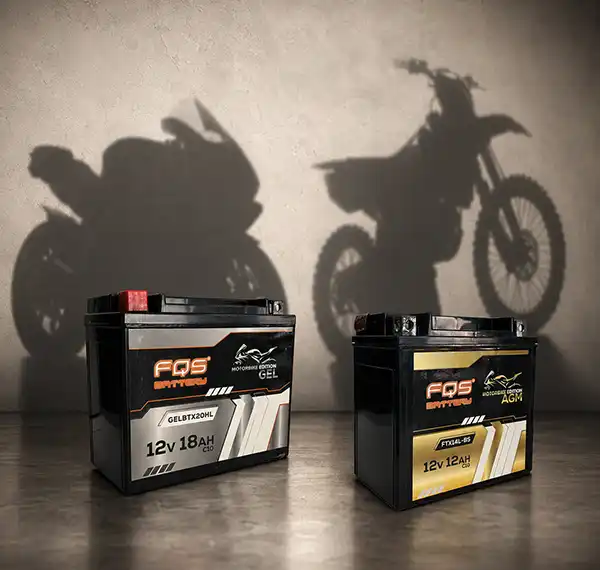
Although they may look similar from the outside, an AGM battery and a GEL battery do not operate in exactly the same way.
In AGM technology, the electrolyte is absorbed into glass fibre separators. This makes the battery highly stable, resistant to vibrations and capable of delivering strong starting power, which is especially valuable in medium- and high-displacement motorcycles, in cold climates, or in vehicles that require a quick response when the key is turned. In fact, it is an ideal technology for most motorcycle applications.
In GEL technology, the electrolyte is immobilised in gel form. This provides very good resistance to deep discharges, low self-discharge and reliable performance when the motorcycle remains unused for long periods or powers more electrical consumers, such as GPS devices, heated grips, auxiliary lighting or other accessories. It is a particularly suitable option for high-end motorcycles and scooters, seasonal use, off-road riding and applications with higher electrical demand.
WHEN TO CHOOSE AN AGM BATTERY
An AGM battery is usually the most logical choice when looking for:
- High starting power
- Good performance in cold weather
- High resistance to vibrations
- Standard or general-purpose application
- Reliable response in motorcycles used frequently.
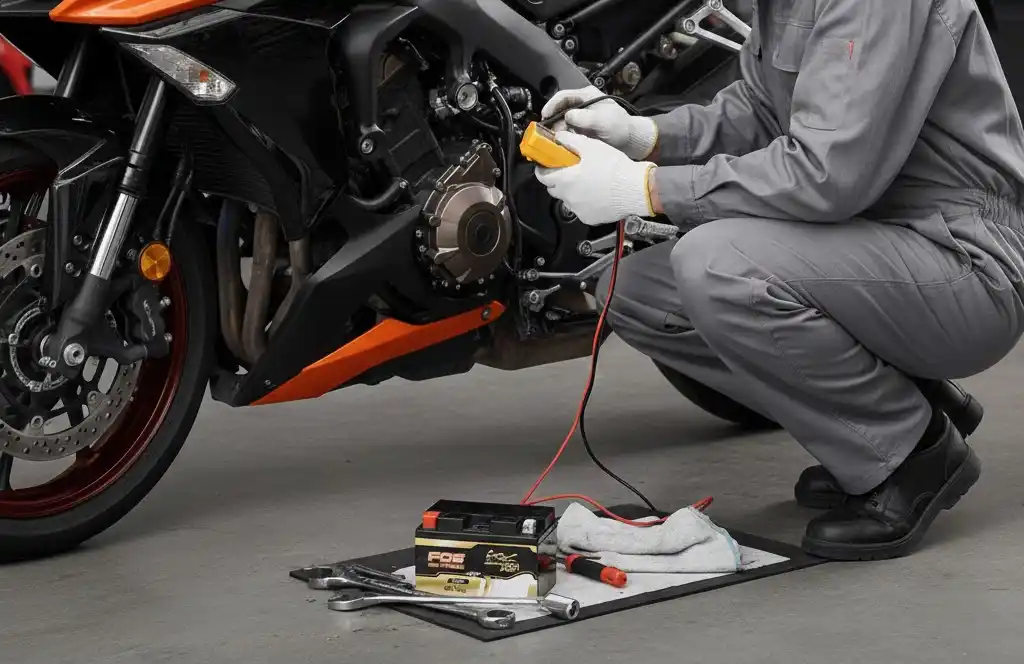
It is a very well-balanced technology and, in many cases, the most suitable for everyday use. If the motorcycle is originally equipped with an AGM battery, the usual recommendation is to continue using AGM unless full technical equivalence has been clearly confirmed. AGM motorcycle batteries stand out for their starting power, their resistance under demanding conditions and their suitability for a large part of the motorcycle fleet.
WHEN TO CHOOSE A GEL BATTERY
A GEL battery makes more sense when the motorcycle’s use demands more than just reliable starting. It is a very interesting option if one or more of these scenarios apply:
- The motorcycle remains unused for long periods.
- There is additional electrical consumption.
- Good tolerance to deeper discharges.
- The vehicle is used seasonally.
- Very stable performance is prioritised in motorcycles with more equipment.
This does not mean that GEL is “always better”, but rather that it may be more suitable when the usage pattern places greater strain on the battery or when there are accessories that increase energy demand. It is a premium solution for motorcycles, scooters and sports vehicles with higher electrical requirements.
KEY DIFFERENCES BETWEEN GEL AND AGM
1.Starting power
If the absolute priority is strong starting power delivery, AGM usually has the advantage. It is especially well suited to cold conditions and to motorcycles where starting needs to be particularly powerful.
2. Seasonal use and periods of inactivity
This point deserves a careful distinction. Both AGM and GEL can perform properly in seasonal use as long as they are kept well charged. However, GEL stands out for its very low self-discharge and its good performance during long periods of inactivity. AGM can also perform very well in this scenario, but only if voltage is monitored and the battery is properly maintained.
3. Deep discharges
Cuando la batería va a sufrir descargas más profundas o ciclos más exigentes, la GEL suele ofrecer ventajas. Por eso puede ser especialmente interesante en motos con accesorios o en usos menos regulares.
4. Vibrations and mechanical stress
Both technologies offer very good resistance to vibrations compared with conventional solutions. AGM stands out particularly in extreme and high-performance applications, while GEL also delivers excellent performance, including in off-road use.
IT IS NOT ONLY THE TECHNOLOGY THAT MATTERS, BUT ALSO THE TECHNICAL SPECIFICATIONS
A battery may be AGM or GEL and still not be the right one for a specific motorcycle. To make the right choice, at the very least the following must be checked:
- Voltage
- Capacity (Ah)
- Starting Power
- Dimensions and polarity
- Compatibility with the motorcycle’s charging system
Understanding the battery specifications is essential to making the right choice, and remember that in motorcycles the voltage and the exact specification are by no means a minor detail.
CORRECT CHARGING ALSO DETERMINES SERVICE LIFE
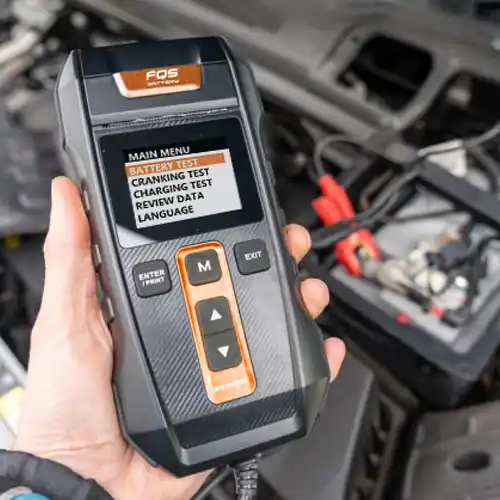
Many batteries that “fail” prematurely do not fail because they are AGM or GEL, but because of inadequate charging, long periods in a discharged state or incorrect maintenance. During periods of inactivity, at FQS BATTERY we recommend checking the voltage regularly and recharging when necessary. It is also important to remember that these batteries should be recharged if they drop below 12.45 V in 12 V systems.
That is why it is advisable to follow three basic rules:
- Use a smart charger compatible with the battery technology.
- Do not leave the battery discharged for weeks or months.
- Check the voltage periodically if the motorcycle is going to remain unused.
ENTONCES, ¿AGM O GEL?
The correct answer is this:
- AGM, when you are looking for a well-balanced solution with strong starting power, very good resistance and general suitability for most motorcycles.
- GEL, when the motorcycle has higher electrical demand, remains unused for longer periods, or the application requires better tolerance to deep discharges and very low self-discharge.
CONCLUSION
When replacing a motorcycle battery, it is not advisable to choose by intuition. The key is not to decide which technology sounds better, but which one best matches the motorcycle and its actual use.
Both AGM and GEL are advanced and reliable technologies, but they are not simply interchangeable. The best decision is to respect the vehicle’s specification, assess the actual electrical requirements and always use a battery with the correct voltage, capacity, starting power and charging system. That is the difference between a proper replacement and a choice that will end up causing problems sooner than expected.