


Following the publication about whether batteries discharge when stored on the ground, we have received numerous questions about the evolution of starting batteries in the automotive sector, from their origins to the present day.
Therefore, from FQS Battery, in this article we aim to provide a clear summary of how starting batteries have evolved over the years, highlighting the milestones and technological advances that have marked their development.

Gaston Planté’s Lead-Acid Battery (1859)
Gaston Planté invented the first rechargeable lead-acid battery in 1859. His design consisted of two rolled lead plates immersed in a sulfuric acid solution.
Original Design
- Structure: Two lead plates rolled in a spiral, separated by cloth or rubber.
- Electrolyte: Diluted sulfuric acid, which enables the electrochemical reaction.
- Operation: During charging, the lead converts to lead dioxide (PbO₂) on the positive plate and to spongy lead (Pb) on the negative plate. During discharge, both react to form lead sulfate (PbSO₄), releasing energy.

1 – Early Lead-Acid Batteries (1912-1950)
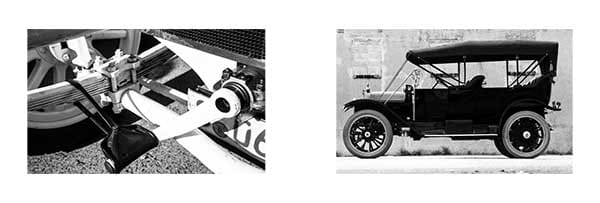
The first automobiles had no electrical systems or starting batteries. They were started with a manual crank.
In 1912, Cadillac marked a milestone in automotive history by becoming the first vehicle in the world equipped with electric start. Presented exclusively in the Four version and available from September 1911, this model offered six body types and achieved a total production of 13,995 units. Its innovation was recorded as a benchmark in the technological evolution of automobiles.
At that time, the first automotive starting battery appeared. These batteries had lead cells and a sulfuric acid electrolyte.
2 – Expansion and Standardization (1950-1980)
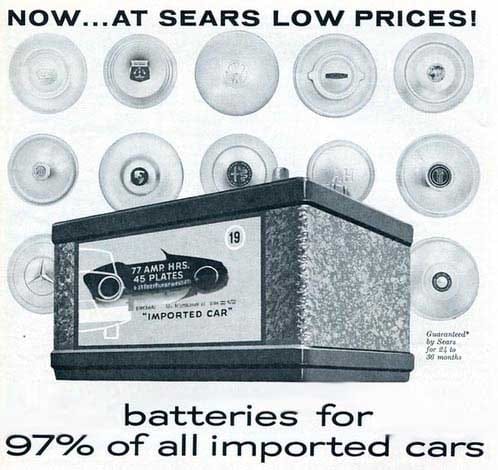
With the incorporation of additional electrical systems—such as lights, radios, and fans—in vehicles, the battery ceased to be merely a starting element and became the primary energy source for multiple devices. This led manufacturers to improve energy density and battery stability. Lead alloy compositions were optimized and manufacturing processes were refined to obtain cells with greater service life, vibration resistance, and the ability to withstand more intense charge and discharge cycles. As a result, batteries offered consistent performance, even under demanding operating conditions.
From 6V to 12V
In the early decades of automotive history, many vehicles used 6V batteries. However, as the demand for electrical power grew, it became necessary to adopt a system that would enable more effective starting and the simultaneous operation of multiple devices. The transition to the 12V system was established as standard for several reasons:
- Greater Starting Power: A 12V system facilitates engine starting under adverse conditions.
- Compatibility with Complex Electrical Systems: Enables the integration of new electronic and safety equipment without compromising performance.
- Energy Optimization: Standardization facilitated mass production and maintenance, reducing costs and improving reliability in the supply chain.
3 – Maintenance-Free Batteries (1980-2000)
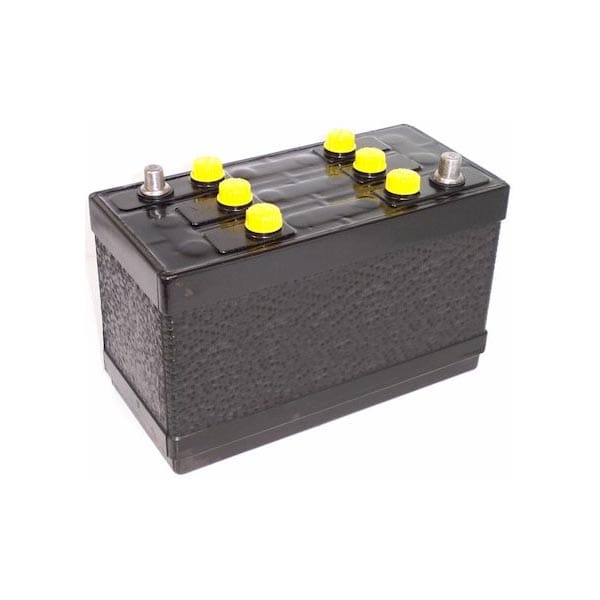
The introduction of sealed batteries with no need to add water represented a qualitative leap in the design and maintenance of starting batteries. These sealed batteries eliminate the need for periodic interventions to replenish water, which reduces the risk of leaks and spills and facilitates simpler and safer maintenance, especially in environments with vibrations and sudden movements.
In addition, greater durability was achieved thanks to improvements in lead alloy composition. Optimization in the composition of the plates, which incorporated elements capable of reducing self-discharge, allowed batteries to maintain their charge for longer periods and offer more consistent performance throughout their service life.
Another important advance was the use of improved separators and reinforced internal construction. These elements work to minimize the formation of lead sulfate crystals (sulfation), one of the main factors that deteriorate battery capacity and performance over time. Next-generation separators facilitate optimal electrolyte circulation, helping to preserve electrochemical efficiency and extend the operational life of the device.
Regarding the battery casing, this component also underwent significant changes in its materials. Traditionally, casings were manufactured with materials such as ebonite (which is a material composed of elastic rubber among other materials) or even glass, which offered limited protection against adverse operating conditions. With technological advancement, high-resistance plastic materials were adopted, such as ABS and polypropylene.
The main improvements obtained with these material changes:
- Resistance to corrosion and heat: These plastics are highly resistant to the corrosive action of sulfuric acid and can withstand the high temperatures generated during the charge and discharge process.
- Greater impact resistance and durability: The new generation of casings offers better protection against impacts, vibrations, and other mechanical factors, reducing the risk of breakage or deformation.
- Hermetic seal and safety: The ability of these materials to conform precisely enables optimal sealing, preventing the entry of moisture or impurities that could affect the internal operation of the battery.
- Flame-retardant properties: In addition, flame-retardant formulations have been incorporated that improve safety, minimizing fire propagation in case of overcharge or internal failures.
4 – GEL, AGM, and LITHIUM Technology (2000-PRESENT)
- AGM (Absorbent Glass Mat) and GEL batteries appear, with greater efficiency and vibration resistance.
- They are used in vehicles with Start-Stop systems and high-performance vehicles.
- Electrification drives the use of lithium-ion batteries in electric and hybrid vehicles.
- Lithium batteries are lighter, last longer, and charge faster than lead-acid batteries.
- Advances in solid-state batteries promise even greater improvements in efficiency and safety. However, they are not yet ready for market release.

Conclusion
The evolution of starting batteries for vehicles has been remarkable over the years, progressing from rudimentary manual starting systems to sophisticated devices that ensure efficiency, durability, and safety. From the introduction of the first rechargeable lead-acid batteries to the consolidation of maintenance-free, AGM, and GEL technologies, and the revolution represented by lithium-ion batteries, each stage has responded to the growing demands of a constantly changing automotive sector.
Today, facing the varied needs of the market, FQS batteries offer the ideal solution, providing the safety and performance required, whether for traditional, high-performance, or electric vehicles. With FQS, every user finds the confidence of having proven technology adapted to the current and future challenges of transportation.