
Deep cycling a battery refers to a process in which the battery is discharged to a very low capacity before being recharged again to its maximum capacity. This term mainly applies to rechargeable batteries such as lead-acid, nickel-cadmium (NiCd), nickel-metal hydride (NiMH), and some lithium-ion batteries.
This process is common in batteries specifically designed for applications that require deeper discharges, such as deep-cycle batteries used in recreational vehicles, solar systems, golf carts, boats, backup power systems, among others.
Deep cycling can have an impact on service life and battery performance. Deep-cycle batteries are designed to withstand repeated deep discharge and recharge cycles, allowing them to last longer and maintain consistent performance throughout their service life.

At FQS Battery, we would like to remind you that it is important to note that not all batteries are designed for deep cycling. Car starter batteries, for example, are designed to provide quick starting power but are not intended to be fully discharged on a regular basis. Misusing this type of battery in deep-cycling applications can significantly reduce its service life.
Therefore, when considering deep cycling a battery, it is important to select a battery specifically designed for that application and follow the manufacturer’s recommendations regarding depth of discharge and expected cycle life.
More specifically:
- Deep discharge: This is the process in which the battery is discharged to a very low level of its total capacity, often below 20%. Some batteries designed for deep cycling can withstand discharges of up to 80% of their rated capacity without suffering significant damage.
- Full recharge: This is the process in which, after a deep discharge, the battery is fully recharged until it reaches its total capacity.
Deep cycling applications
Batteries designed for deep cycling are common in applications that require a sustained power source over an extended period, such as:
- Solar power systems
- Golf carts
- Electric vehicles
- Backup power systems (UPS)
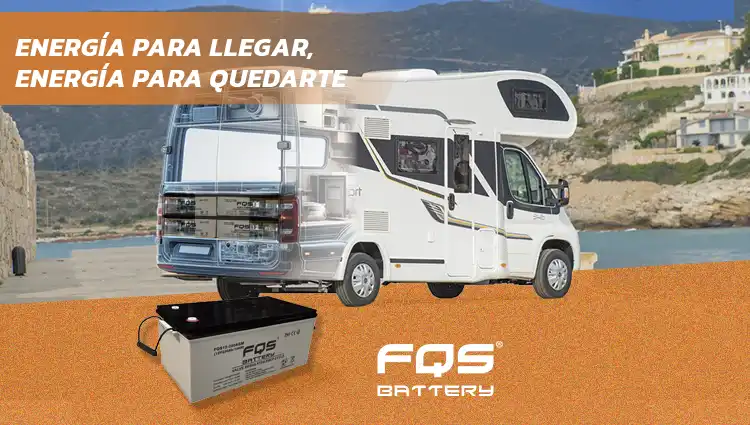
- Caravans and motorhomes
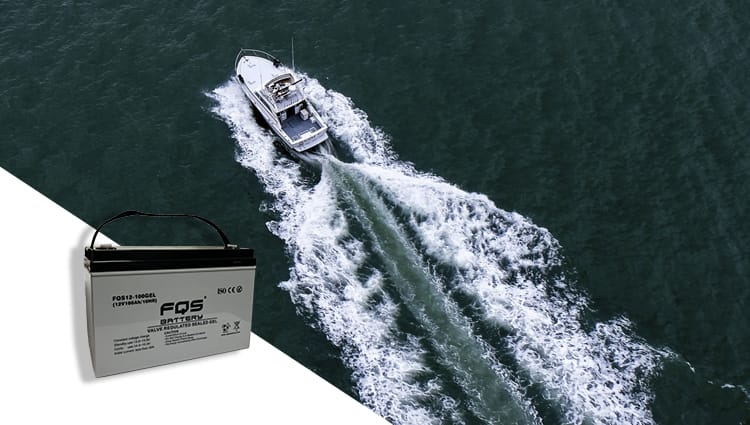
- Boats and recreational vehicles

Battery technology
Deep-cycle batteries can come in different technologies depending on the type of application, operating conditions, and performance requirements.
At FQS Battery, we market the following ranges:
- Flooded (maintenance-free acid)
- Tubular
- AGM
- AGM Carbon
- GEL
- Heavy Traction
- LiFePO4
Advantages and disadvantages
- Sustained energy capacity: They provide a steady, sustained power source over extended periods.
- Durability: They are designed to withstand multiple deep discharge cycles without degrading quickly.
Disadvantages
- Weight and size: They are often heavier and bulkier compared to batteries designed for shallower discharges.
- Initial cost: They tend to be more expensive due to their robust construction and ability to withstand repeated deep cycles.
- Maintenance: Some deep-cycle batteries, such as lead-acid batteries, require regular maintenance, such as checking and adding distilled water.
Points to consider
Deep cycling can help prevent “memory” in certain batteries such as NiCd, where battery capacity is reduced if it is not fully discharged before being recharged. However, not all batteries are suitable for deep cycling. For example, lithium-ion batteries generally should not be deeply discharged on a regular basis, as this can reduce their service life.
In summary, deep cycling is a useful and necessary method for certain applications and battery types, ensuring optimal performance and extending the service life of batteries designed for this purpose.
If you have any questions or enquiries, our specialists are always available. Contact us and at FQS Battery we will provide you with the best solutions.