

Heat gives no warning. It silently deteriorates the starter battery during the sunniest months, and when it finally fails on the first cold morning in December, we almost always blame the cold. At FQS BATTERY, we have been seeing this happen for more than 16 years, and it is worth telling the story the other way round
There is a scene that plays out every winter in workshops across our network. A frustrated driver comes in: the car would not start that morning, during the first real frost. “The battery suddenly died because of the cold.” And the answer is almost always the same: that battery did not die during the frost. It died in August. The cold simply exposed the damage.
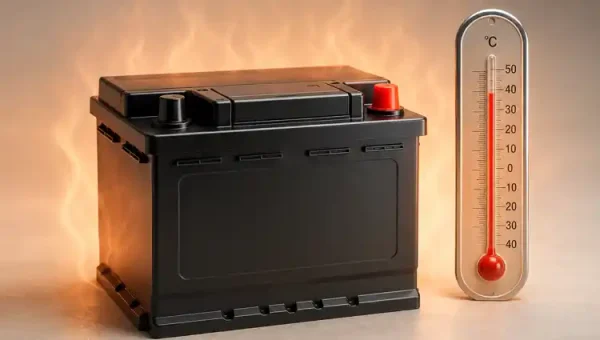
This is the great paradox of the lead-acid battery, both the conventional type and those used in modern Start-Stop vehicles. It fails in the cold, but deteriorates in the heat. Winter does not damage it; it exposes its weakness. To understand why, we need to take a brief look at what happens inside that box that almost no one pays attention to until it leaves them stranded.
WHAT HEAT DOES TO IT ON THE INSIDE
A battery is pure chemistry, and chemical reactions speed up as the temperature rises. That may sound good in theory—more reaction, more energy—but in practice, heat accelerates the very processes we want to avoid.
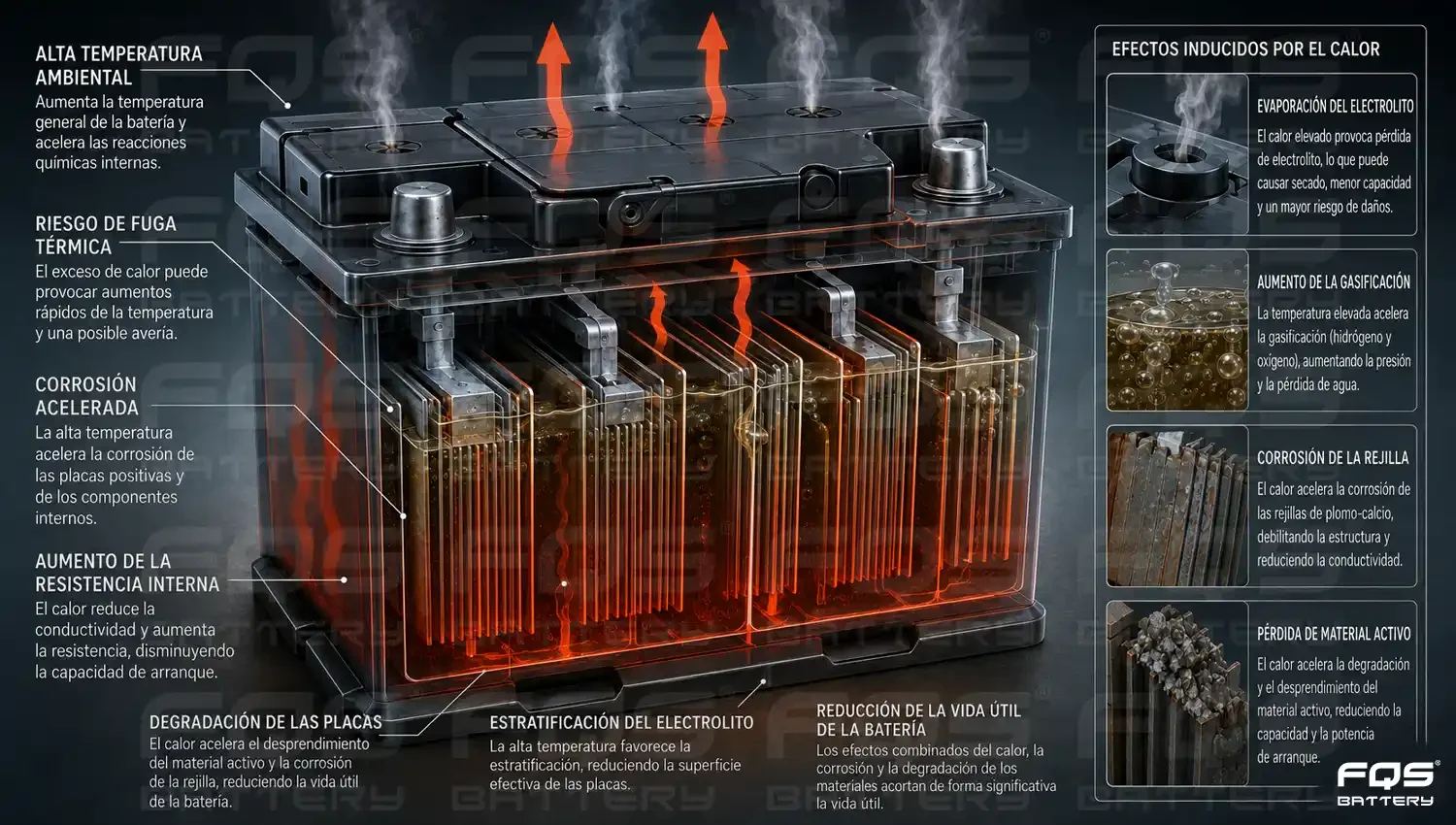
The first is water loss. The electrolyte contains water which, above a certain temperature, begins to evaporate and escape as gas. If the level drops and exposes the plates, that part of the battery stops working and sulphation occurs. In older batteries with removable caps, you could top them up with distilled water. In today’s sealed batteries, including the AGM and EFB technologies fitted to Start-Stop vehicles, there is nothing to open: once the water is lost, it cannot be replaced.
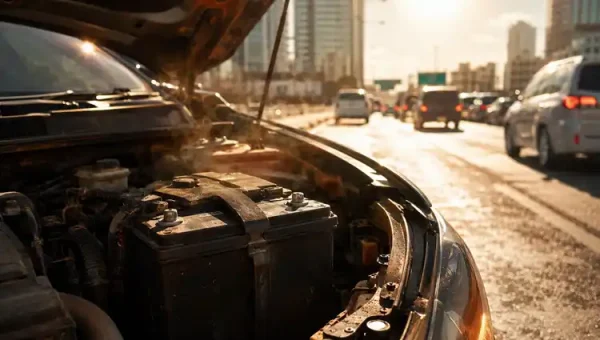
he second—and the one that has the greatest impact on service life—is grid corrosion. The positive plate gradually oxidises over time, and heat accelerates this deterioration. It is a slow process, invisible from the outside, that eats away at the internal structure until, one day, the battery can no longer deliver the surge of current required by the starter motor. This is where a rule of thumb used in the industry, from Battery Council International, applies: for every sustained increase of 8 to 10°C above 25°C, battery life is roughly halved. It is not a precise laboratory measurement, but a practical guideline. However, it explains why a battery that may last five or six years in a mild climate often lasts no more than three or four in the hot summers of southern Spain.
The third is self-discharge. In hot weather, a parked car loses charge on its own much more quickly. A car left in the sun for two weeks in an airport car park in August will not be in the same condition when you return.
A deteriorated battery does not always stop working suddenly. In many cases, it shows warning signs that drivers should not ignore:
SIGNS OF A WEAKENED BATTERY
- The engine cranks more slowly when starting.
- The lights dim when you try to start the vehicle.
- The Start-Stop system frequently stops working.
- Battery or electrical system warning messages appear.
- The electric windows, climate control or other equipment operate less effectively.
- Memory settings are lost or reset.
- The terminals show signs of corrosion or poor connections.
- The casing shows deformation, cracks, moisture or signs of leakage.
A Start-Stop vehicle may restart its engine dozens of times a day, rather than just once. That is why it is fitted with FQS BATTERY AGM or EFB technology batteries, which offer greater resistance to repeated cycling.
THE CAR MAKES THINGS EVEN HARDER
In the past, batteries had a relatively easy life. Today, they work much harder and under harsher conditions. The engine compartment, where everything is tightly packed to improve aerodynamics and maximise space, can reach extremely high temperatures—and the battery is often located there, effectively baking in the heat. It is no coincidence that some manufacturers have moved it to the boot or beneath a seat, or fitted it with a thermal cover as standard.
There is another factor that almost no one checks and which can wreak havoc in summer: overcharging. The alternator regulator should reduce the voltage when the battery is hot. If it fails and continues charging at full power with temperatures of 40°C under the bonnet, it can boil the electrolyte and dry out the battery within weeks. Many “defective batteries” that arrive at workshops are actually victims of a charging system that no one bothered to check.
WHAT DRIVERS CAN DO
The good news is that almost everything that extends a battery’s life in summer is inexpensive or free. There are no miracle solutions—just common sense applied in time.
- Park in the shade.
A garage can be fifteen degrees cooler than the street at midday, and your battery will benefit from this every day. - Have it checked before the heat sets in.
Do not wait until the car no longer starts. A load test with a battery tester takes five minutes and will tell you whether it is likely to last through the summer or is nearing the end of its life. - Keep the terminals clean and tight.
White or greenish corrosion increases electrical resistance. A brush, suitable terminal grease and a quick check that the battery is securely fastened are all you need. - If the car will be unused, connect a battery maintainer.
Self-discharge accelerates in summer, and a battery left discharged for weeks will begin to sulphate. - Check the alternator’s charging voltage.
If it is overcharging, no battery will withstand the heat of August. A workshop can check this in no time.
KNOWING WHEN IT IS TIME TO REPLACE THE BATTERY
No battery lasts forever, particularly in a hot climate. If yours is approaching four years old and another harsh summer is on the way, it is often more cost-effective to replace it in advance than to push it to the limit and risk a breakdown at the worst possible time. The warning signs are well known: sluggish starting, particularly when the engine is hot; lights that dim when starting; and a swollen or deformed casing, which is almost always a sign of overcharging or excessive heat. If the casing is damaged, there is little room for debate: replace the battery. Until the new one arrives, keeping a portable jump starter in the boot can save you a lot of trouble.
Looking after your battery in summer means focusing on the basics: shade, a timely inspection, terminals in good condition and avoiding leaving it discharged in the sun. Nothing spectacular, but it can make the difference between a battery that reaches its expected service life and one that fails without warning on the first cold morning—when it is too late to do anything except call roadside assistance.