

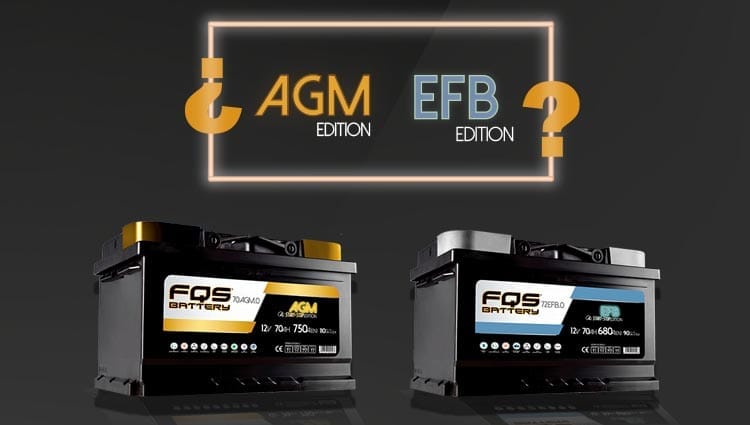
AGM batteries (Absorbent Glass Material) are batteries that are increasingly being fitted in the latest-generation cars.
Designed for vehicles equipped with START&STOP technologies and regenerative braking.
The general characteristics of these batteries are excellent:
- High cold cranking capacity
- They withstand deep discharges
- Designed for high charge peaks
- Absorbed electrolyte instead of using sulfuric acid as the electrolyte, making them more environmentally friendly than conventional flooded lead-acid batteries.
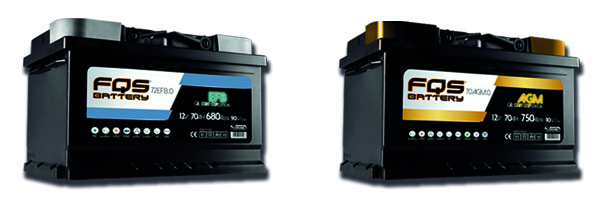
At FQS BATTERY, we are frequently asked whether an AGM battery can be fitted in a car that has an EFB battery, and vice versa.
We also often hear that “where an EFB is fitted, an AGM can be fitted, but where an AGM is fitted, an EFB cannot be fitted”.
And we find that a vital consideration is being overlooked: AGM battery charging requirements are different from those of conventional batteries and EFB batteries. Overcharging or undercharging your AGM battery will irreparably damage it and significantly reduce its service life.
Therefore, if we want to fit an AGM battery in a vehicle equipped with a standard alternator charging system designed for flooded lead-acid batteries, we will have serious problems. The AGM battery will be undercharged or overcharged, its service life will be much shorter, and it will discharge much faster.
In addition, vehicles that are already a few years old lack the battery’s float charge state*. In these cases, if we install an AGM battery, we significantly increase the risk of, for example, overheating on long journeys.
*Float charging is the process whereby, when the battery is already 100% charged, the alternator operates at low, constant levels to compensate for self-discharge, but at levels that do not overheat the battery.
REPROGRAMMING THE ALTERNATOR CHARGING VOLTAGE
Many newer vehicles already offer the possibility to reprogram and adjust the charging voltage to what an AGM battery actually needs without damaging it. When the battery is installed, it requires programming that directly adjusts the charging levels.
In addition to regulating charging levels, it must be ensured that it has a regulator that correctly sets not only the charging voltage levels but also the limit of the charging current. Otherwise, the AGM battery will not reach 100% charge and its capacity and service life will be reduced.
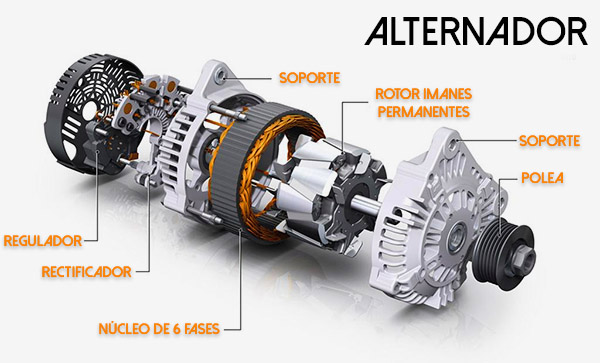
POINTS TO CONSIDER
AGM batteries, which truly are SUPERBATTERIES, are much more sensitive to high temperatures than other batteries. Exposure to high temperatures will significantly reduce their service life and performance.
It means it is not ideal for them to be, as in many conventional vehicles, under the bonnet. Because depending on the area where you live, when installed in that location it will reach high temperatures and its service life and performance will be compromised.
If we look at cars that come from the factory with AGM batteries fitted, they are usually located under the front passenger seat, in the boot, or in another more protected location.
Also, the closer the battery is to the engine, the more heat it will be exposed to when the car is running. As we can see, it is not only the ambient temperature that affects it.
REGENERATIVE BRAKING
If we think about regenerative braking, heavy braking generates a very high charge peak in a very short period of time.
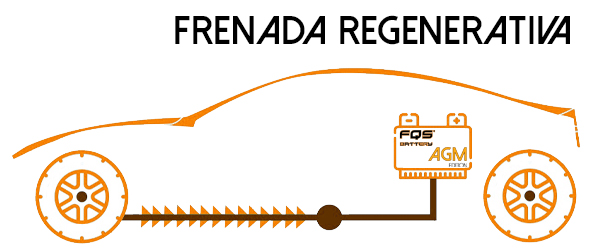
These peaks are not supported by EFB batteries, and even less so by conventional ones. In addition, peaks would occur with every braking event. That is, continuously, or at least very frequently, we would be using the battery in an unsuitable way for which it is neither designed nor capable.
In the graph below, we can see these charge and discharge peaks according to the different technologies.

THEREFORE, OBVIOUSLY, WE CANNOT FIT AN
EFB BATTERY WHERE AN AGM BATTERY IS REQUIRED
OUR RECOMMENDATION
Our recommendation at FQS BATTERY is to select for the vehicle the same type of battery it comes with as standard. The manufacturer will fit a battery with the technology and characteristics that will ensure the vehicle delivers optimal performance, and for which its systems are designed.
If you decide to replace your EFB battery with an AGM battery, you must have taken the above points into consideration to ensure that the change will allow your vehicle to operate under the ideal conditions. Otherwise, the battery will last much less than expected and will not deliver the desired performance.
However, switching from a conventional battery to an EFB battery does not pose any problem or risk. In fact, it is an improvement. No different requirements are needed. The change will mean a better-performing battery, greater durability with up to 3 times more cycle performance, greater resistance to vibrations for passenger cars, and superior starting power—regardless of whether the car has a START&STOP system.